


2019-10-12
Сложение скоростей через глобальные векторы
В этой заметке мы покажем, как складываются две скорости, если известны их глобальные векторы, полученные путём преобразования Лоренц-фактора.
Метод позволяет получить классическую релятивистскую формулу такого сложения [1] только лишь при помощи векторной алгебры, без инерциальной и движущейся систем отсчёта, наглядно, и без применения дифференцирования.
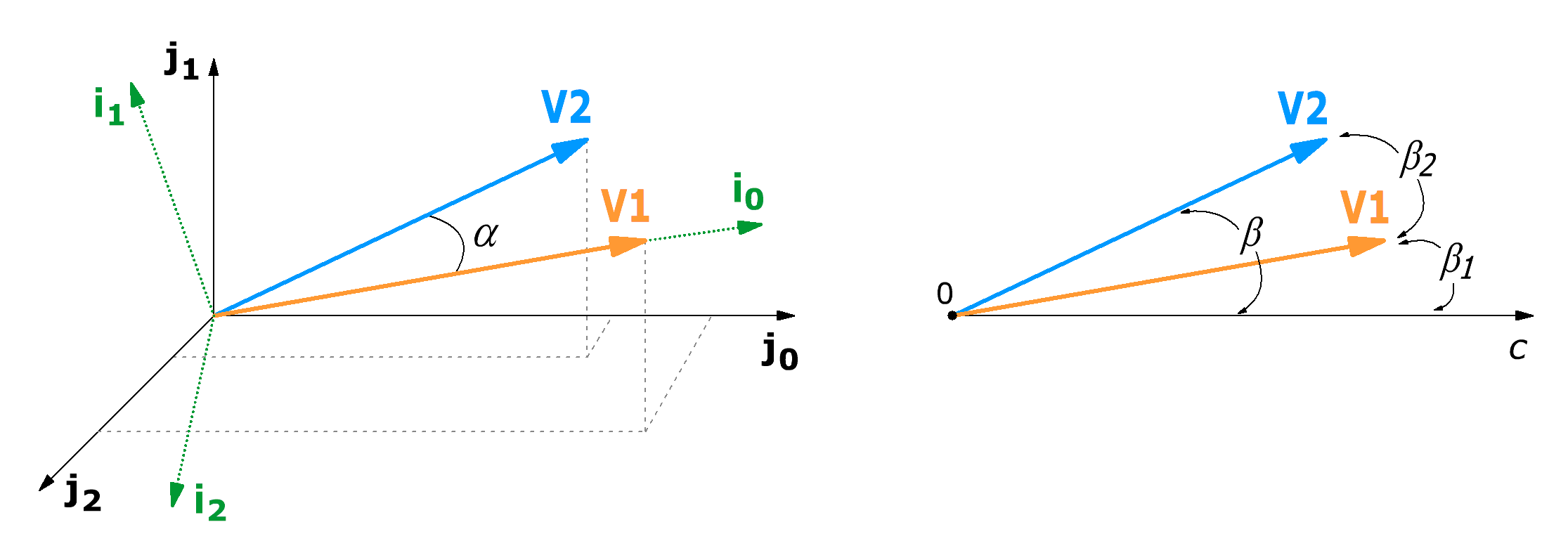
Рис.1. Два глобальных вектора скорости и их ортогональные базисы.
|
Итак, пусть у нас имеются два глобальных вектора скорости (рис. 1) \(\mathbf{V1}\) и \(\mathbf{V2}\),
и мы знаем, как они определяются относительно их общего ортогонального базиса \((\mathbf{j_0, j_1,\ldots ,j_n})\).
Этот базис далее мы будем опорным.
Необходимо также заметить, что на рисунке мы можем отобразить только три координаты из их бесконечного числа.
Первый вектор развёртывается исходя из скорости \(v_1\) из реального пространства, которая берётся относительно опорного базиса:
\[\mathbf{V1} = \frac{c}{\gamma_1} \sum \limits_{n=0}^{\infty} \mathbf{j_n} \beta_1^n, \quad \beta_1 = v_1/c \qquad (1.1)\]
Второй вектор развёртывается исходя из скорости \(v\), которая также берётся относительно опорного базиса,
но представляет собой релятивистскую сумму скоростей \(v_1\) и \(v_2\), которую нам и предстоит найти в этой работе:
\[\mathbf{V2} = \frac{c}{\gamma} \sum \limits_{n=0}^{\infty} \mathbf{j_n} \beta^n, \quad \beta = v/c \qquad (1.2)\]
где: \(\gamma_1,\, \gamma\) — Лоренц-факторы.
Заметим: поскольку мы считаем, что пространство первого и второго вектора имеют одинаковые характеристики,
то знаки (+ или -) перед коэффициентами также должны быть одинаковыми, а значит мы можем выбрать любые, т.к. далее они будут попарно перемножаться.
Здесь мы выбрали все плюсы, но результат будет такой же при любых других комбинациях.
Как известно из векторной алгебры, косинус угла между такими векторами будет находиться так:
\[\cos(\alpha) = {\mathbf{V1}\cdot \mathbf{V2} \over |\mathbf{V1}| |\mathbf{V2}|} \qquad (1.3)\]
Модули этих векторов всегда равны \(c\):
\[|\mathbf{V1}| = |\mathbf{V2}| = c \qquad (1.4)\]
Скалярно перемножая эти два вектора мы получим искомый косинус угла:
\[\cos(\alpha) = {1 \over \gamma_1 \gamma (1 - \beta_1 \beta)} \qquad (1.5)\]
Также, мы можем создать ещё один ортогонального базис, который мы разместим на базе первого вектора \((\mathbf{i_0, i_1,\ldots ,i_n})\), при этом:
\[\mathbf{i_0} = {\mathbf{V1} \over |\mathbf{V1}|}, \quad |\mathbf{i_0}| = 1 \qquad (1.6)\]
Тогда, используя преобразование Лоренц-фактора уже на новый базис мы получим,
что второй вектор, уже относительно первого, может быть записан так:
\[\mathbf{V2} = \frac{c}{\gamma_2} \sum \limits_{n=0}^{\infty} \mathbf{i_n} \beta_2^n, \quad \beta_2 = v_2/c \qquad (1.7)\]
где: \(v_2\) — скорость в реальном пространстве, в системе координат первого вектора.
Таким образом получается, что скорость \(v_1\) можно рассматривать, как скорость первой точки относительно опорного базиса,
а скорость \(v_2\) можно рассматривать, как скорость второй точки, но уже относительно первой.
Теперь мы снова можем найти тот же косинус угла, но уже между \(\mathbf{i_0}\) и \(\mathbf{V2}\):
\[\cos(\alpha) = {\mathbf{i_0}\cdot \mathbf{V2} \over |1| |\mathbf{V2}|} = \frac{1}{\gamma_2} \qquad (1.8)\]
Учитывая, что \(\gamma_2 = {1 / \sqrt{1 - \beta_2^2}}\), и что косинус угла в формуле (1.5) совпадает с (1.8), остаётся эти формулы приравнять
\[\gamma_1 \gamma (1 - \beta_1 \beta) = \gamma_2 \qquad (1.9)\]
и вывести из них \(\beta_2\):
\[\beta_2 = \pm {\beta - \beta_1 \over 1 - \beta_1\beta_2} \qquad (1.10)\]
Исходя из нашего рисунка (1) мы должны выбрать знак плюс, следовательно окончательная формула станет такой:
\[\beta_2 = {\beta - \beta_1 \over 1 - \beta\beta_1} \qquad (1.11)\]
Полученная формула сама по себе показывает релятивистский результат, но мы можем преобразовать её в классический вид,
в котором базис \((\mathbf{j_0, j_1,\ldots ,j_n})\) будет считаться неподвижным,
а базис \((\mathbf{i_0, i_1,\ldots ,i_n})\) — будет двигаться относительно него со скоростью \(v_1\).
Относительно последнего — точка будет двигаться со скоростью \(v_2\).
Требуется найти \(v\), представляющая сумму скоростей \(v_1\) и \(v_2\) относительно первого базиса.
Для этого достаточно вывести \(\beta\) из формулы (1.11):
\[\beta = {\beta_1 + \beta_2 \over 1 + \beta_1\beta_2}\, \quad v = {v_1 + v_2 \over 1 + v_1 v_2 / c^2} \qquad (1.12)\]
Формула (1.12) представляет классическую форму записи релятивистской суммы двух скоростей [1].
Опытным путём такой результат впервые обнаружил Физо ещё в 1851-м году [2].