

1. The General approach
The algorithm is based on the method of conversion of input data (VD) public-key (OKL), and the method of permutation resulting from the conversion data by the private key (SCL). OKL is transmitted together with VD obtained from the encoded string (SSTR), and its location in TSTR is calculated according to the algorithm with SQL. The last known only to the transmitting and receiving side. Getting VD from str in the reverse order.
The algorithm may consist of one or several blocks, each of which has its own public and private keys. The inclusion of several series-connected units increases the cryptographic strength. In Fig.1 shows two blocks, but next will be described the algorithm of one of them. Others work just as well.
The algorithm is simply implemented on any platform. The platform should support decimal and hexadecimal numbers (summation, subtraction and conversion from one format to another), and have the opportunity to work with substring. Platform limitation is determined only by the size of the VD.
2. Description of the data encryption algorithm
Over 2.1 VD is the algebraic transformation algorithm [1]. This may be a simple summation with OKL', and disable' in the General case can be function from FCL, SCL and other data. To do complex transformations in this part of the algorithm does not make sense, and the task is to mask VD. The data obtained will be called a Line.
2.2 Next, the String is converted by the method of permutation to form a so-called "holes". The holes represent the location in obtained after permutations of the String that have a sequence number, but do not yet have values. The order rearrangement and the formation of holes defines SCL [2].
2.3 In holes obtained in P2.2, is inserted approx algorithm [3]. Space the holes determines the SCL. Thus SSTR contains the transformed VD and approx.

Fig.1
3. Description of the algorithm decrypt data
In Fig.2 shows a diagram of the decryption of the data. The scheme consists of two cascaded blocks, but next will be described the algorithm of one of them. Others work just as well.
3.1 Of SSTR using SQL removed is unknown until approx algorithm [4].
3.2 SSTR is converted by the method of permutation algorithm [5]. The obtained data then will be called a Line.
3.3 Above the Line is the algebraic transformation algorithm [6]. The result is VD. VD input (Fig.1 Block1) and VD at the output (Fig.2 Option1) are equivalent.
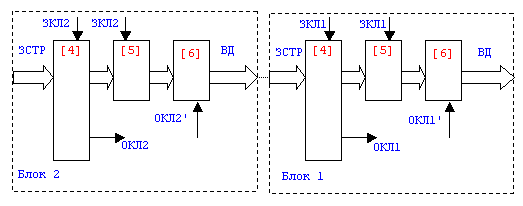
Fig.2
4. Generating SQL
SCL cannot be any combination of characters or numbers, it has to be generated by a special algorithm [8]. Moreover, for each block (two-unit example in Fig.1) it needs to be unique. The generation is done once, after which SQL is issued to the transmitting and receiving side, and should be known only to them.
The implementation of the algorithm module UAcoder | Testing algorithm and module
[1] the Algebraic transformation implies that any algebraic operations on the data:f(VD,OKL') — algebraic function from VD and approx', while in the General case: OKL'=f(FCL,SCL,...);

Fig.3
[2] This part of the Algorithm is crucial and involves the permutation of Rows depending on the SCL. As a result of rearrangement is obtained, a new line, and formed the so-called "holes", which are then populated with approx. We introduce a definition: INTERNAL — up to the reshuffle, PSTR — the String after permutation, i is the number of element in BR, j is the element number in the PSTR, k — number of the element in SCL. The line item will call the value a single character string, having a sequence in her room. All rooms are starting from scratch. The algorithm for the next permutation. Is a sequence of atomic bust and fitted bodice. Furthermore, k=i until such time as k is less than the length of the SCL. Then k=(i)mod(L), where L is the length of SCL, i.e. quite simply the expense of k starting from scratch each time k reaches L. Swap the i-th element INTEGRATED in the j-th element PSTR according to the rule: j=i+Zk, where Zk is the value k of the element SCL. After moving all INTERNAL we get MID length greater than the INTERNAL length SCL negative one. This means that PSTD has "holes" — i.e. places with no values. [3] the algorithm of the lookup disable in holes like this. In the first left-to-right hole is inserted the first element of OCP, the second second and so on until, until all holes are filled. The number of holes are searched by the algorithm [7]. In the example from [2] (Fig.4) it will look like: -BACDFEGH-- => 5BACDFEGHD0, where OKL is equal to 5D0. [4] algorithm for the extraction of OCPs from SSTR like this. Find the number of holes in the algorithm [7], hereinafter referred to as ND. Fetching the value from the first LP, and substitute it in place of the first element OKL. In place of the second element OKL substitute the value of the second LP, etc., until you get all the elements OKL. I.e. this algorithm, the backward algorithm [3]. [5] This algorithm is permutation — backward algorithm [2], but in this case INTERNAL — famous Line at the entrance, and MID — yet unknown String at the output of the algorithm. Create a PSTR of zeros (or other values) with a length equal to the length of VSTR minus the number of holes. Produced by a sequential atomic bust and fitted bodice. Thus k=i until such time as k is less than the length of SCL, and then k=(i)mod(L). Substitutable for the i-element VSTR j-th element PSTR according to the rule: i=j-Zk, where Zk is the value k of the element SCL. Thus the output of the algorithm is obtained PSTR length less than the length of VSTR to the number of holes. [6] the Algorithm of algebraic transformations should be the inverse of the algorithm [1]. 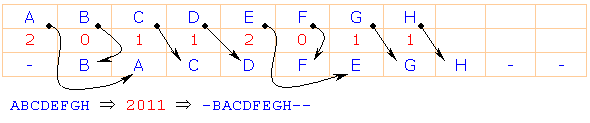
Fig.4
f(ST,OKL') — this is an algebraic function of ST and OKL that ST=f(VD,disable'), while in the General case: OKL'=f(FCL,SCL,...); is the same as in [1].

Fig.5
[7] the Algorithm for finding the numbers of holes in the line is just to check the availability in the first and last N-1 line numbers. N is the radix of the OCPs (for example, the hexadecimal number system is 16). In the example from [2] (Fig.4) it will be a place: 0,9,10.
Vyacheslav Gorchilin, 2004
* Reprinting of the article and the module are possible with the links on the website and respect the copyright