

2019-10-02
An isolated space. Introduction
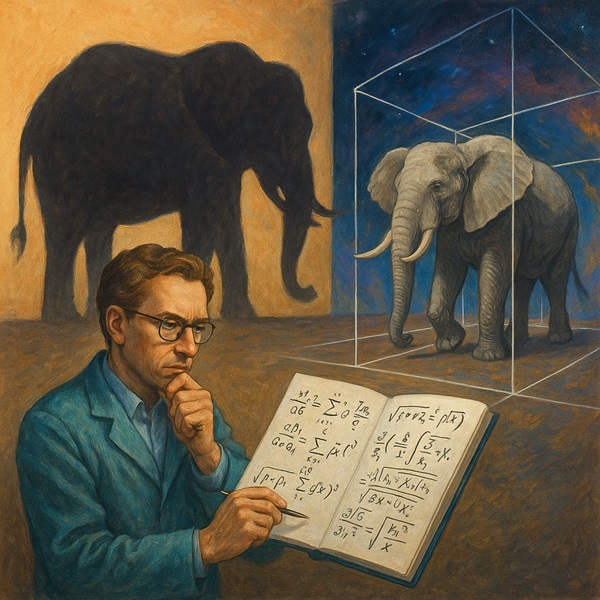
Modern science sometimes resembles a person trying to study an elephant by examining its shadow — and attributing to the shadow all the properties of the elephant itself. As a result, the formulas become complex and often unintelligible, reflecting only a projection, not the essence. The task of a new physics is to see the elephant itself. And to do that, it must go beyond the familiar 3D and learn to operate within a space of many dimensions.
 Hello, dear readers! This topic was started by me over 20 years ago. Some work was received in different periods of time that I have tried to collect in a single system under the title — "single space". The name chosen by chance, because the module or length of the global vector of velocity, which it describes, will always be equal to one. By the way, there immediately follows a global law of conservation of energy.
 Based on the many-worlds and Copenhagen interpretations of quantum mechanics [1–2], we will distinguish between two types of space: actual and real. Real space is the familiar world with three spatial dimensions and time (3 coordinates + time = 4D), where velocities, accelerations, and masses exist. It represents just one of the possible manifestations of actual space. Actual space, in contrast, is capable of encompassing all possible scenarios and is multidimensional, in fact, infinite-dimensional. It is within this actual space that remarkable phenomena occur, which we perceive in our real space only as reflections or projections. The transition from actual space to real space is made possible through one of the properties of the global vector — convolution.
The projection of actual space onto our four-dimensional world (4D) carries a deeper meaning than a classical geometric projection. To emphasize this distinction, we will refer to it as convolution. Convolution is not only a geometric projection but also the collapse of the wave function, where only one of the possible scenarios is realized.
The concept of a global velocity vector lies in the constancy of its length (modulus) which is always equal to the speed of light. From here immediately follows that the massless energy of the geometric points are always the same and equal to the square of the speed of light. This is consistent with our reality and automatically sets a global law of conservation of energy for the whole present further hypotheses. Based on this concept, also, is the convolution of the global vector for our 4-dimensional space-time (example).
Our hypothesis does not draw a strict distinction between the temporal and spatial axes of coordinates. If a point moves at the speed of light, the spatial axis of a stationary observer transforms into the time axis for that point. Conversely, for the stationary observer, the time axis of the moving point is perceived as a spatial axis. Thus, space and time become interchangeable depending on the frame of reference — fundamentally differing from the Minkowski spacetime model, where temporal and spatial coordinates remain categorically distinct.
The advantage of hypothesis of a unit space is the absence of imaginary coordinates or angles that are required in classical relativistic theory. However, this does not prevent to obtain the same results while using only simple and clear steps of vector algebra, and often, even to dispense with the use of differentiation and integration (example).
One of the remarkable implications of the hypothesis presented here is that acceleration, as a physical quantity, is inherently multidimensional. This opens up the possibility of redistributing acceleration across vectors belonging to different spatial frameworks. In practical terms, this suggests the emergence of devices capable of redirecting acceleration forces. With such technology, any vehicle could come to a stop or accelerate almost instantaneously — without causing the slightest harm to its occupants.
Despite the fact that the ideas were received in random order I have arranged them sequentially as possible :). In this order I would recommend you to study this subject: the substance of the section.
The materials used
- Wikipedia. Many-worlds interpretation.
- Wikipedia. The Copenhagen interpretation.