


2025-09-23
Квадратный корень из гиперболической единицы и 4D пространство
То, чего не может быть
Математика постоянно открывает новые формы чисел, расширяя наше представление о пространстве и симметрии.
В этой работе рассматривается следующий шаг — введение особой единицы, которая позволяет построить новое четырёхмерное пространство с естественными правилами умножения и богатой геометрической интерпретацией.
Хорошо известна формула Эйлера [1], где экспонента содержит в показателе степени мнимую единицу, с помощью которой, в общем случае, можно организовать 2D пространство над \(\mathbb{R}\):
\[ e^{ix} = \cos x + i \sin x \]
где: \(i\) — мнимая единица [2].
В этой работе мы получим пространство 4D над \(\mathbb{R}\) при помощи новой мнимой единицы, обладающим рядом преимуществ в сравнении с аналогичными алгебрами.
В числе прочих — коммутативность алгебры, математически обоснованный базис, чем не могут похвастаться, например, кватернионы [3].
Но начнём — с гиперболического аналога формулы Эйлера для пространства 4D:
\[ e^{\it x} = a + \is^1 b + \is^2 c + \is^3 d \]
Представленная здесь алгебра изоморфна \(\mathbb{C} \oplus \mathbb{C}\) и может быть раскладываться над подалгебры, например, на пару комплексных чисел и работать с ними независимо.
В ней легко вводить сопряжения, нормы, и работать с рядами вида \(e^{\iota x}\).
Здесь можно строить и отражения, и более экзотические перестановки между степенями. То есть симметрий потенциально больше, чем у кватернионов.
Новое мнимое число
Известно \(\i\) — гиперболическое число, квадрат которого равен плюс один [4].
На его основе введём новое мнимое число:
\[\tag{1} \it = \sqrt{\mathstrut \i} \]
Назовем новое мнимое число «йота» — по имени этого символа.
Более строгое его наименование — гиперкомплексная мнимая единица четвёртого порядка.
Необходимо заметить, что получить значение такого квадратного корня в области действительных или даже комплексных чисел невозможно.
Для его описания требуется расширение до гиперкомплексных чисел.
Покажем, почему это так.
- В области вещественных чисел \(\sqrt{\mathstrut \i}\) невозможен, потому что \(\i\) там вообще не существует (ведь \(\i^2 = +1\), но \(\i \ne \pm 1\)).
- В области комплексных чисел тоже не получится: если бы \(\i\) принадлежала \(\mathbb{C}\), то из \(\is^2 = \i\) следовало бы, что \(\i \in \mathbb{C}\). Но в комплексных числах не существует элемента, квадрат которого равен \(+1\), кроме \(\pm 1\). А нам нужен новый, независимый от них.
- Следовательно, \(\it = \sqrt{\mathstrut \i}\,\) — это новая гиперкомплексная единица, которая требует расширения алгебры \(\mathbb{C}\).
Некоторые косвенные пути для понимания нового числа мы изложим чуть ниже.
А пока найдём степени этой новой единицы:
\[\tag{3} \is^1 = \is, \quad \is^2 = \i, \quad \is^3 = \i \is, \quad \is^4 = 1 \]
Хорошо заметно, что эти значения будут повторяться через каждые четыре шага.
Это свойство мы будем активно использовать далее.
В степенной ряд, представляюший собой разложение экспоненциальной функции по Маклорену [5]
\[\tag{4} \exp x = \sumn0 {x^n \over n!}, \]
подставим
\[\tag{5} x = \ia \]
Получится следующий ряд с повторяющимися мнимыми коэффициентами при его членах:
\[\tag{6} \exp(\ia) = 1 + \it {\a^1 \over 1!} + \ik {\a^2 \over 2!} + \i\it {\a^3 \over 3!} + 1 {\a^4 \over 4!} + \it {\a^5 \over 5!} + \ldots \]
Такой ряд, очевидно, можно разбить на четыре частичных суммы \(S_0 \ldots S_3\), каждая из которых может быть представлена в виде скалярной функции:
\[\tag{7} \exp(\ia) = S_0 + \is^1 S_1 + \is^2 S_2 + \is^3 S_3 \\
S_0 = \sum \limits_{n=0,4,8,\ldots}^{\infty} {\a^n \over n!} = \frac12 (\ch\a + \cos\a) \\
S_1 = \sum \limits_{n=1,5,9,\ldots}^{\infty} {\a^n \over n!} = \frac12 (\sh\a + \sin\a) \\
S_2 = \sum \limits_{n=2,6,10,\ldots}^{\infty} {\a^n \over n!} = \frac12 (\ch\a - \cos\a) \\
S_3 = \sum \limits_{n=3,7,11,\ldots}^{\infty} {\a^n \over n!} = \frac12 (\sh\a - \sin\a) \\
\]
Здесь: \(\ch, \sh\) — гиперболический косинус и синус.
Графики функций таких частичных сумм приводятся на следующем рисунке:
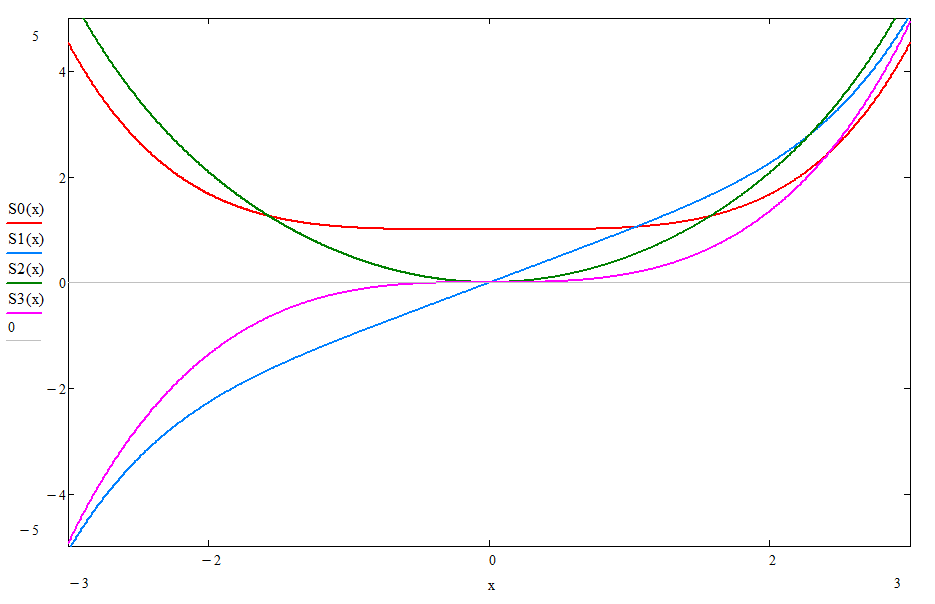
|
Можно сделать проверку, если сложить эти частичные суммы без мнимых коэффициентов.
В результате мы снова получим функцию экспоненты:
\[\tag{8} S_0 + S_1 + S_2 + S_3 = \exp\a \]
Проверить частичные суммы можно и таким способом:
\[\tag{9} S_0 - S_1 + S_2 - S_3 = \exp(-\a) \]
Также, могут быть интересны некоторые сочетания квадратов частичных сумм:
\[\tag{10} S_0^2 + S_1^2 + S_2^2 + S_3^2 = \ch\!^2 \a \\
S_0^2 - S_1^2 + S_2^2 - S_3^2 = \cos^2\!\a \]
Можно получить и совсем неочевидные комбинации:
\[\tag{11} S_1^2 + S_3^2 = 2 S_0 S_2 \\
S_0^2 + S_2^2 = 1 - 2 S_1 S_3 \]
Такие тождества могут оказаться полезными для работы с модулями.
Более развёрнуто они будут представлены в следующем разделе этой работы.
Модуль и сопряжённая сумма
Сопряжённую функцию к \(\exp(\ia)\) удобно определить заменой \(\it \mapsto -\it\).
Тогда разложение (7) принимает вид:
\[\tag{12} \overline{\exp(\ia)} = \exp(-\ia) = S_0 - \is^1 S_1 + \is^2 S_2 - \is^3 S_3 \]
Алгебраический модуль определяется аналогично комплексному случаю —
как произведение функции на её сопряжённую:
\[\tag{13} |\exp(\ia)| = \sqrt{\,\overline{\exp(\ia)} \cdot \exp(\ia)} = 1 \]
В то же время евклидова норма в пространстве коэффициентов \((S_0, S_1, S_2, S_3)\) вычисляется по формуле:
\[\tag{14} \sqrt{S_0^2 + S_1^2 + S_2^2 + S_3^2} = \ch a \]
Таким образом, алгебраический модуль и евклидова длина определяются по-разному, и имеют различное значение.
Геометрический смысл
Алгебраический модуль (13) показывает, что экспонента с мнимой единицей \(\it\) всегда остаётся на «алгебраической окружности» радиуса 1, аналогично тому,
как \(e^{i a}\) описывает единичную окружность в комплексной плоскости.
Евклидова норма (14), напротив, характеризует геометрию пространства коэффициентов и задаёт поверхность гиперболической сферы в четырёхмерном пространстве.
Таким образом, модуль и евклидова длина описывают разные структуры:
первый связан с внутренней симметрией алгебры, второй — с геометрией действительного 4D-пространства.
Введём 4D пространство
Определение.
Пусть \(\it\) — гиперкомплексная единица, такая что
\[\tag{15} \is^2 = \i, \quad \i^2 = 1, \quad \is^4 = 1 \]
Тогда множество всех выражений вида
\[\tag{16} z = S_0 + \is^1 S_1 + \is^2 S_2 + \is^3 S_3, \quad S_l \in \mathbb{R}, \]
образует линейное пространство над \(\mathbb{R}\), которое мы будем обозначать \(\mathbb{R}_{\it}^4\).
Свойства:
- Размерность пространства равна 4, а его базис: \(\{1, \is^1, \is^2, \is^3\}\).
- Умножение в \(\mathbb{R}_{\it}^4\) определяется по правилу степеней \(\it\): \[\is^k \cdot \is^m = \is^{(k+m)\, \mathbb{mod}\, 4}. \]
- В отличие от кватернионов, умножение здесь коммутативно и ассоциативно.
- Множество \(\mathbb{R}_{\it}^4\) является одновременно и алгеброй, т.е. в нём определены линейные операции и согласованное умножение.
По сути, это можно назвать новым 4D гиперкомплексным пространством на базе \(\it\), так как оно не совпадает ни с кватернионами, ни с обычными комплексными числами, ни с двойными числами.
Сравнение с комплексным случаем
Для обычных комплексных чисел экспонента имеет вид
\[ e^{i x} = \cos x + i \sin x ,\]
а её модуль равен
\[|e^{i x}| = \sqrt{e^{i x} \cdot e^{-i x}} = 1 .\]
В случае гиперкомплексной единицы \(\it\) структура сохраняется: алгебраический модуль \(|\exp(\ia)|\) также равен единице, см. (13).
Однако евклидова норма (14) уже отличается и выражается через гиперболический косинус: \(\ch \a\).
Таким образом, аналогия с комплексным случаем сохраняет «единичную окружность», но дополняется новым гиперболическим слоем в пространстве коэффициентов.
Кроме того, вмеcто 2D мы получаем 4D пространство.
Сравнение с кватернионами
Кватернионы имеют три мнимые единицы \(i,j,k\) и являются некоммутативной алгеброй.
Их модуль задаётся евклидовой нормой
\[|q| = \sqrt{a^2 + b^2 + c^2 + d^2}, \]
и сохраняется при всех вращениях группы автоморфизмов SO(3).
В отличие от них, гиперкомплексная система с единицей \(\it\) остаётся коммутативной и обладает более богатым набором сопряжений.
Новая алгебра сочетает свойства комплексных чисел (сохранение модуля) и расширенные гиперболические симметрии, которых у кватернионов нет.
В отличие от кватернионов, где мнимые единицы \(i,j,k\) и правила их перемножения вводятся как постулаты например,
\[ ij = k, \quad ijk = -1, \]
то в случае гиперкомплексной единицы базис и правила умножения всех его степеней вытекают из строго математических соотношений.
Так, из определения \(\is^2 = \i\) следует
\[ \it \cdot \is^2 = \is^3, \quad \is \cdot \is^3 = 1, \quad \is^2 \cdot \is^3 = \it, \]
и т.д. — то есть вся алгебра, и её базис, строится естественным образом через степени и их свойства.
Выводы
В данной работе введена новая гиперкомплексная мнимая единица четвёртого порядка \(\it\), определяемая как квадратный корень из гиперболической единицы.
Построенная на её основе алгебра \(\mathbb{R}_{\it}^4\) образует 4-мерное пространство над \(\mathbb{R}\), отличное как от комплексных чисел, так и от кватернионов и двойных чисел.
Основные свойства нового пространства:
- коммутативность и ассоциативность умножения;
- естественный базис, возникающий из степеней \(\it\), а не постулируемый, как в случае кватернионов;
- наличие нескольких согласованных определений модуля и сопряжений;
- развитая структура симметрий, включающая как комплексные аналоги, так и новые гиперболические преобразования.
Таким образом, предложенная конструкция открывает возможность рассматривать экспоненциальные функции, ряды и геометрические интерпретации в новом гиперкомплексном пространстве.
Её дальнейшее изучение может быть полезно как в чисто алгебраических исследованиях, так и в приложениях, где требуются новые способы описания многомерных симметрий.
Перспективы
Естественный следующий шаг, — ввести ещё одно новое гиперкомплексное число: \(\sqrt{\it}\) и получить пространство йота-октанионов 8D.
По такому же принципу можно получить и более мощные пространства с размерностью \(2^N\).
Все они будут обладать преимуществами представленной здесь алгебры, например коммутативностью и ассоциативностью.
Такие структуры могут найти применение в моделировании многомерных симметрий, квантовой физике, теории струн и теории информации, где требуется естественная работа с высокоразмерными числами.
Используемые материалы
- Википедия. Формула Эйлера.
- Википедия. Мнимая единица.
- Википедия. Кватернион.
- Википедия. Гиперболическое число.
- Википедия. Ряд Тейлора и Маклорена.